Pacific Islands
The Pacific Ocean covers more than a third of the Earth's surface. Scattered across it — from Melanesia to Polynesia to Micronesia — are thousands of islands, atolls, and archipelagos, many of which owe their human settlement to a single plant: the coconut palm. Polynesian navigators carried coconuts across the Pacific as a portable food, drink, and building material, establishing settlements on islands where few other crops could survive. The coconut didn't just enable Pacific migration — in many cases, it made it possible.
But the Pacific palm story extends well beyond the coconut. New Caledonia harbors the extraordinary Red Leaf Palm (Chambeyronia macrocarpa), prized worldwide for its shocking crimson new growth. Vanuatu is home to both the delicately perfect Ruffled Fan Palm (Licuala grandis) and the critically endangered Aneityum Palm (Carpoxylon macrospermum), one of the rarest plants on Earth. Fiji and Tonga claim the Fiji Fan Palm (Pritchardia pacifica), planted for centuries at ceremonial sites. The Pacific basin, for its relatively small land area, has produced a remarkable concentration of distinctive and deeply significant palms.
One Palm, 200 Uses
Pacific Island cultures document more than 200 uses for the coconut palm — from food and drink to medicine, fiber, construction, fuel, and religious ceremony. It is the single most versatile plant in human history.
Red, Then Green
The Red Leaf Palm (Chambeyronia macrocarpa) produces new leaves in a vivid crimson that can last for weeks before gradually fading to green. No other palm does this quite so dramatically. The mechanism is the production of anthocyanins — the same pigments that color autumn leaves.
200 Trees Left
The Aneityum Palm (Carpoxylon macrospermum) is one of the rarest plants on Earth. It exists on only two small islands in Vanuatu, with fewer than 200 individuals confirmed in the wild. Our cultivated specimens represent a small but meaningful portion of the global population of this species.
Palms of This Region
The coconut palm's relationship with Pacific Island peoples is one of the most comprehensive human-plant relationships in history. From the green husk used to start fires, to the shell used as a vessel, to the meat eaten fresh or dried for copra, to the sap fermented into toddy or distilled into arrack, to the leaves used for thatching, basketry, and broom-making, to the trunk used for construction — virtually no part of the coconut palm is wasted. It is estimated that a single mature coconut palm can produce 50–200 coconuts per year. For the atolls of Micronesia and Polynesia, where soil is thin and freshwater scarce, the coconut was not a convenience — it was survival. But that same ubiquity carries a conservation cost: coconut monocultures now dominate more than half the tree cover on many Pacific atolls, displacing the native forest ecosystems that preceded human settlement.
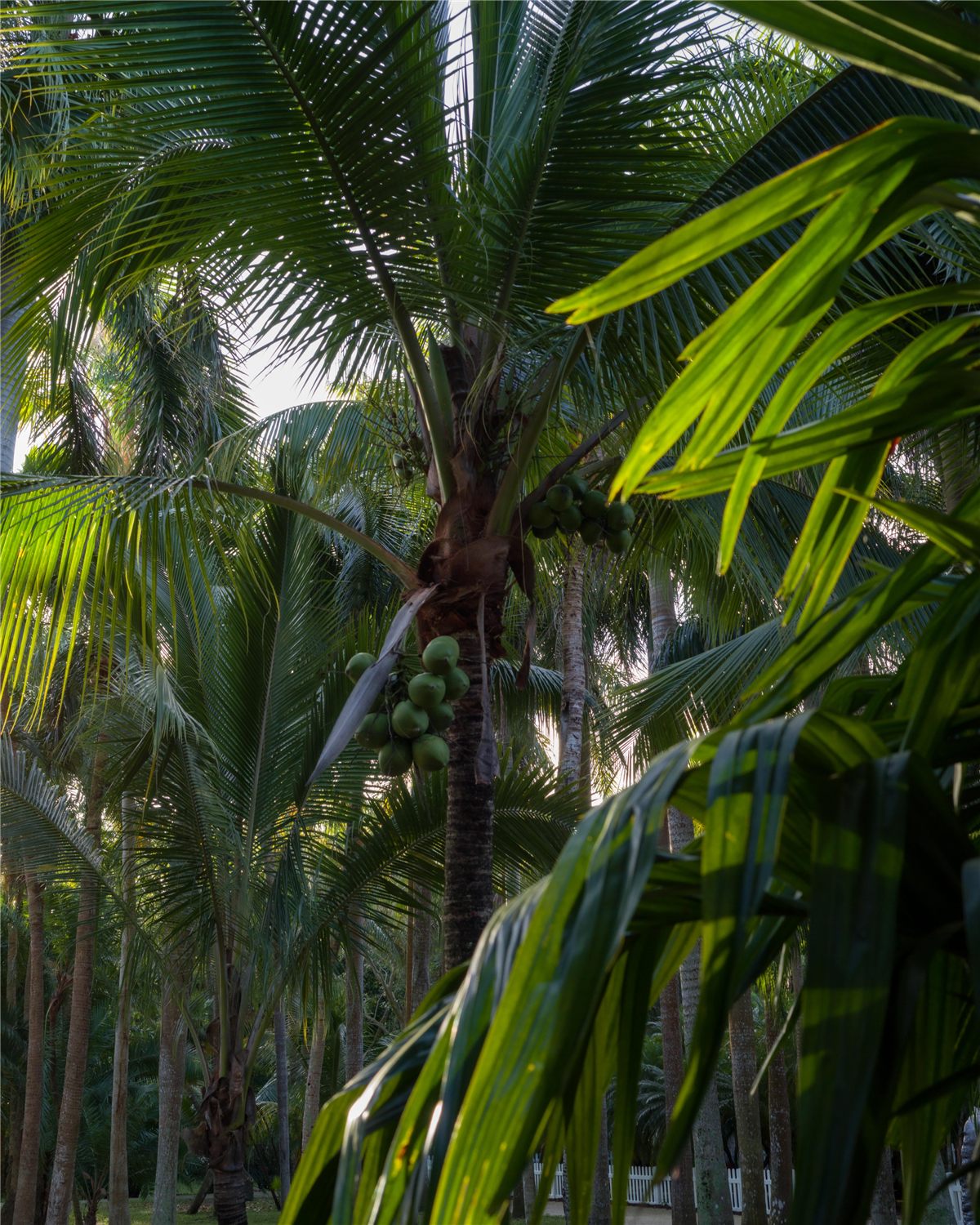
Coconut Palm
No plant has traveled further, fed more people, or been more deeply embedded in human culture than the coconut palm. Its exact origin is debated — likely the coasts of Southeast Asia or the western Pacific — but through both natural ocean dispersal and deliberate human transport, it spread across the entire tropical world before European contact. A single mature tree can produce 50–200 coconuts per year for 60–80 years. The water is sterile and isotonic — it was used as an emergency IV fluid during World War II in the Pacific theater when medical supplies ran short. Our specimen at Paradise Palms reflects both the palm's global significance and its particular centrality to Pacific Island life.
Red Leaf Palm
The Red Leaf Palm earns its name every time it produces a new frond. The emerging leaf unfolds in a brilliant crimson — vivid enough to stop visitors mid-path — before gradually deepening, then fading over weeks to the standard dark green of a mature frond. The mechanism is a high concentration of anthocyanin pigments in young leaf tissue, which protects the developing chlorophyll from sun damage until the leaf matures. Endemic to New Caledonia, this palm is found naturally in humid montane rainforests. It has become one of the most sought-after collector palms in the world — and one of the most satisfying to encounter in person.
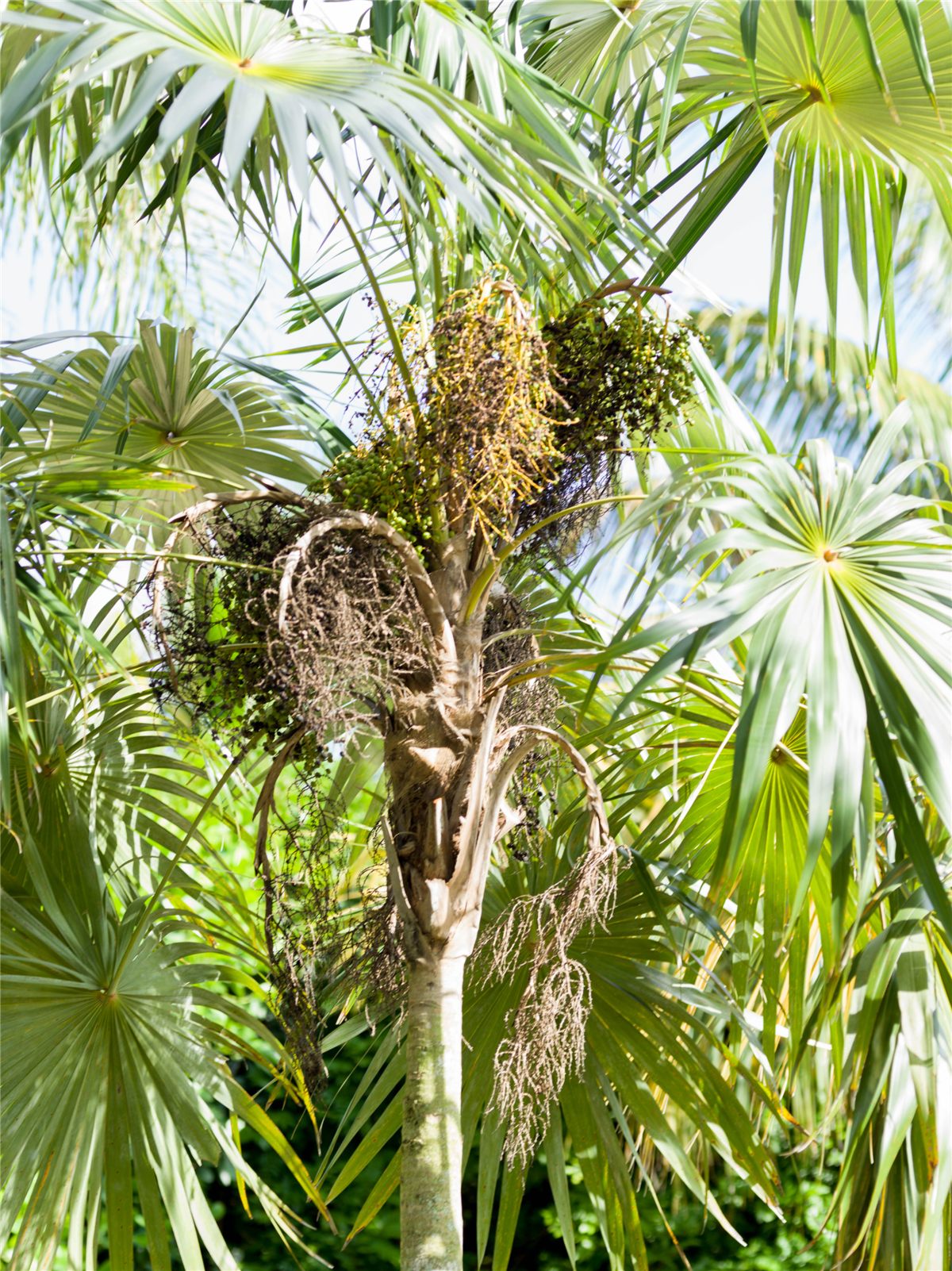
Aneityum Palm
The Aneityum Palm may be the most endangered palm species in our entire collection. With fewer than 200 known individuals surviving in the wild — all on two small, remote islands in Vanuatu — it occupies one of the narrowest ranges of any palm on Earth. It is the only species in its genus, an isolated evolutionary branch without close relatives. Its seeds are extremely difficult to germinate and its growth is slow. Our cultivated specimens exist within a very small global population of this species held in botanical collections. To see it growing here is to see something genuinely irreplaceable.
Fiji Fan Palm
The Fiji Fan Palm is one of approximately 25 species in the Pritchardia genus, most of which are endemic to the Hawaiian Islands — making P. pacifica, native to Fiji and Tonga, a geographically distinctive outlier. It is a large, commanding palm with broad, pleated fan leaves and a stately, upright crown. Across Fiji and Tonga, it has been traditionally planted at bure (ceremonial houses), chiefly residences, and sacred sites — a physical marker of cultural significance. It is both a beautiful ornamental and a living record of Pacific Island cultural geography.